Wednesday, November 11, 2009

Strategic Planning Analogy #290: Strategy is A Location


THE STORY
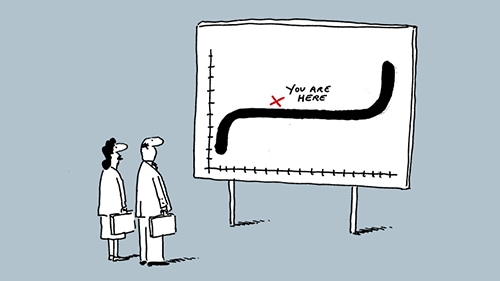
What if we thought of our mental condition as being like a location on a map? Then, if someone said “I am in a state of confusion,” we could just tell them to “Get in a car and drive to a different state, like the state of Contentment.” The United Mental States of America could have all sorts of interesting states. I think we already have a lot of politicians from the state of Denial.

Just think of how much money you could make selling maps showing the best path for getting from a bad mental state (like the state of Despair) to more desirable locations (like the state of Bliss). Wait a minute! Isn’t that basically what travel agencies do? Isn’t that what all those psychological self-help books try to do? Is Dr. Phil nothing more than just a seller of maps?

Continuing with this idea, if someone said “I think I am going crazy,” you could reply “How can you be going to a place where you already live? You’ve been in the land of Crazy for years.”

THE ANALOGY
Strategic planning tends to deal with a lot of abstract concepts. This is particularly true when it comes to strategic positioning. To make these abstractions easier to understand and work with, it can be useful to follow the example in the story.

In the story, the idea was to take abstract mental conditions and treat them as physical locations on a map. In the same way, I think there are benefits to looking at the abstract concepts of strategic planning as if they were positions on a map.

THE PRINCIPLE
The principle here is that strategies may be easier to understand and create if we think of them as being a location. In fact, there are three different ways to apply this principle.

1. Strategic Success Depends Upon Locating Yourself Properly on the Consumer’s Mind Map
Consumers act based on how they think. Hence, if you desire a certain consumer behavior, one needs to first get the consumer to think in a particular way about that behavior. In other words, you need to locate your product or brand in a specific location in the consumer’s mind if you want your strategy to succeed.

Where is that ideal location in the brain? It will vary based upon your strategy, but all successful locations will address the three S’s. The first S stands for “slot.” Different parts of the brain are used, depending upon the type of problem the brain is trying to solve. One of your first strategic tasks is to decide what problem your product is trying to solve.

Perhaps you are trying to solve the problem of “what’s for dinner?” Or maybe you are trying to solve the problem of preparing the customer for retirement. Then again, the problem could be trying to lower the cost to run your client’s factory.

There are all sorts of problems to choose from. As part of your strategy, you need to choose the problem you are trying to solve. And I don’t mean an internal problem like “How can I make my company more profitable?” The problem is to be a problem held by your potential customer. This is an important decision, since if you cannot help a consumer with a problem, then you have no relevancy to that customer.

Once you have chosen the problem, you need to make sure that your brand/product is “slotted” into the location of the consumer’s brain concerned with that problem. In other words, whenever that problem turns up for that consumer, you want your name to fire up in that part of the brain. This is done by communicating in a manner which continually associates your brand with that problem.

For example, Crest has spent decades associating its toothpaste brand with the problem of cavity prevention. It is now solidly slotted in the brain, so that when the problem of cavities comes up, the brain immediately thinks of Crest.

The second S is “solution.” Your strategy needs to provide a solution to that problem. What is it about your product/brand that makes it capable of solving that problem? Again, there are often many ways to solve a problem. You have to choose one.

This solution choice includes both the process and the performance. By process, I mean the general approach to solving the problem. For example, if the problem is weight loss, the choice of process could include exercise, diet, surgery, pharmaceuticals, hypnosis, and many others. By performance, I mean the type of attribute emphasized in the process you choose, such as being fastest or cheapest or most comprehensive, etc.

The third S is for “superiority.” It is not good enough to just be located in the brain where the problem is being addressed. You need to be seen as the superior solution to the problem. In Al Reis and Jack Trout’s excellent book Positioning, they refer to this as being a rank ordering, like rungs on a ladder. You want your brand to own the top rung (the best) in the mind of the consumer. So, another role of strategy is to locate your brand on the top rung on the problem ladder. You have to have a convincing argument (both rationally and emotionally) for why you should own that location.

Whenever I work with someone on developing a strategy, I usually end up at some point asking the question “Why should a customer prefer your product over all the other options?” If you have difficulty answering that question, the consumer probably has even greater difficulty coming up with an answer. And if you are not perceived as being the best alternative, they will choose someone else.

For example, for the problem of dependable transportation, Toyota has firmly cemented itself to the top rung location. It is perceived as best at automotive dependability. Through years of effort, Toyota has created a strategy which gives them ownership of that location in the brain of most consumers. They are slotted as the superior solution.

To summarize, your strategy needs to develop a superior means of solving a relevant problem and then place that information on the top rung in the relevant problem-solving location in the consumer’s brain.

2. Strategic Success Depends Locating Yourself Properly on the Competitive Map.
A strategic position is not created in a vacuum. The position plays itself out in the competitive marketplace. You can think of this marketplace as being like a map. Each competitor has a location on that map. The viability of your strategic position depends in large part on where you are on the map relative to everyone else.

For example, let’s say that you are a retailer with a strategy is based on owning the low price solution. Your ability to own the low price position depends a lot on your location on price versus competition. Wal-Mart recently has started a number of price wars in areas such as toys, books and DVDs. As long as Wal-Mart is driven to be closer to the lowest possible price location on the map than you are, you cannot own the low price position, no matter where you set your prices.

So when creating the action plan for your strategy, do not think primarily in terms of absolutes. Instead, think in terms of relativity—where you are relative to others on the map. In other words, if you want to own quality, it is not good enough to just set a high absolute quality level. You need to have higher relative perceived quality than the competition. That can be a moving target.

Often times, it is best to locate yourself on the competitive map is a place that is relatively empty. For example, if everyone else seems to be fighting for space on the quality area of the map, you may be better off going to the price area of the map, which is more wide open. The lest contested a space, the easier it is to own in the mind of the customer.

Right now Chevrolet is trying to convince people that it has the highest quality, most fuel efficient cars available. That is a hotly contested space, already owned by Toyota and Honda. Chevy will have a hard time unseating those entrenched positions. It would have been better off trying to go after a less contested space.

Although Ford would also like to be seen as high quality and fuel efficient, its approach has been less of a direct assault on Honda and Toyota. Instead, Ford is trying to establish itself with superiority in high-tech enhancements. This space is less contested on the competitive map. Once Ford owns this space, it can use high-tech superiority as a justification for a secondary claim at superiority in quality, safety and fuel economy (caused by unique technology).

And when you are building this competitive map, make sure you include every competitor attacking the same problem. For example, if the problem is weight loss, you need to include every process aimed at that solution. You may claim to be the fastest exercise solution for losing weight, but if there is a pill you can take that works a lot faster at losing weight than any exercise, you have not really captured the “speed” space on the map.

3. Strategic Success Depends Upon Locating Yourself Properly on the Map of the Future
Strategy is often about creating a better position in the future than you have today. It is often easier to communicate where you want to take the company if you can visualize that future state on some sort of map. Then, not only can you show the desired future location, but also today’s location and the path you must take in order to get from the one to the other. The mind map or the competitive map may be good templates to show the new destination and transition path to get there.

SUMMARY
Complex concepts can often be better understood, worked with, and communicated if thought of visually—like positions on a map. In strategy, some of the more useful maps would be a consumer mind map, a competitive landscape map, and a future map.

FINAL THOUGHTS
If your strategy cannot be easily translated into a visual map, then it is highly likely that your troops will get lost in strategy execution (and you will not reach the desired destination).

Friday, November 6, 2009

Strategic Planning Analogy #289: Basic Training


THE STORY
Many people have stories about the terrible ordeal they went through in Army basic training (also known as Boot Camp). They tell about how the Sergeants yelled at them unceasingly and how the Sergeants tried to punish and humiliate them in front of the others.

When my son went through basic training, it was relatively painless. The Sergeants pretty much left him alone. I asked him how he was able to do that. His response:

“I quickly found out that there were two groups of people that got picked on. One group was the laggards, who were having trouble keeping up with the rest. They were yelled at to get them to work harder.

“The second group was those who excelled much better than average. They were yelled at to break their egos. The ones in the middle were pretty much ignored. So I tried to be in that anonymous middle at everything we did.”

Leave it to the army to make “aiming for average” a virtue.

THE ANALOGY
One of the key factors to consider in business decisions is risk. Typically, we try to develop strategies that minimize risk (relative to the reward). Even if we cannot eliminate risk, we try to find ways to manage it so that we are best prepared to withstand it.

My son found a way to minimize/manage the risk of punishment and humiliation in the army. He noticed that the risk increased the further he varied from normal, average behavior, either in a positive or negative direction. By hiding in the middle, with the masses, he could avoid a lot of that punishment and humiliation.

This same principle is true in the business world. As we will see later in this blog, many of the most dangerous risks to your business are at the points where you are the most unlike your peers. There is more safety in the anonymous middle.

THE PRINCIPLE
The principle here is that we need to keep a careful eye on those points in our strategy where were stand out from the crowd, because that can often be the source of some of our greatest risks.

Think, for a moment, about the recent financial crisis. At first, the US government thought that the crisis would only impact the outliers who were overly aggressive in the problem mortgages. Therefore, the government was willing to let Lehman Brothers fail, because it was thought to be a rare outlier. However, once it was determined that the financial crisis was going to devastate the anonymous middle of the financial world, the US government put into action a massive bailout program to try to save as many as possible.

By staying in the middle, the risk was minimized. They got a bailout. But Lehman, by appearing to be a little more aggressive, was allowed to fail.

Or let’s suppose that most of the companies in your industry are headquartered in Country A. You are unusual in that you are headquartered in Country B. In your industry, there are many transactions between Country A and Country B. As the currency exchange rate between the two countries vary, it impacts those inter-country transactions.

For the majority, who are all headquartered in Country A, the currency risk is relatively small. Since they all have the same problem, they can adjust fees to compensate and still make about the same amount of money and still be competitive with all the others headquartered there. However, because you are headquartered in Country B, the exchange rates have the opposite impact on your business. When you adjust, you are out of sync with everyone else—sometimes for the good, sometimes for the bad. Your difference in location increases your exchange risk relative to your competition.

In October of 2009, McKinsey & Company released a paper on managing risk. One of the points made in that paper was that some of the largest risks to your business [what they call risk cascades] come at the point where you are the most different from your competition. To quote the paper:

“Companies are particularly vulnerable to this type of risk cascade when their currency exposures, supply bases, or cost structures differ from those of their rivals. In fact, all differences in business models create the potential for a competitive risk exposure, favorable or unfavorable.”

This creates an interesting dilemma. Most of the writings on strategy emphasize the benefits of differentiation. They explain that it is what makes you different that provides the opportunity to become superior in some way to some segment. To quote Michael Porter, “Strategy is about making choices, trade-offs; it's about deliberately choosing to be different.” I talked about this in greater detail in an earlier blog.

Yet, this same benefit from differentiation also increases your risk. My son avoided risk in army basic training by avoiding differentiation. Yet we, as strategists, know that this is not an option for us if we want to excel.

That is why the McKinsey article goes on to say, “The point isn’t that a company should imitate its competitors, but rather that it should think about the risks it implicitly assumes when its strategy departs from theirs.”

You may currently be taking comfort in the elaborate and sophisticated strategy you have put in place. However, a small detail, such as being located in the wrong country, could create a currency risk that puts that entire strategy in jeopardy.

Therefore, when looking for points of risk vulnerabilities, don’t just focus on the grand design of your strategy. Look for the little details where you stand out from the anonymous middle.

Perhaps you are a little more labor intensive, or a little more capital intensive, or you rely on a different set of suppliers. Whatever it is, that little difference puts you at odds with the rest of the industry. That means that when there are corresponding market shifts in labor costs/availability, capital costs/availability or supplier costs/availability, you are effected more than the rest of the market, because you have more at stake.

If you are in the anonymous middle, you adjust similarly with everyone else on these issues and get by. You might even get a bailout. But if you are an outlier, watch out, because that difference can radically decrease your competitiveness when changes occur.

It is impossible to keep track of every issue that could possibly impact your business. There aren’t enough hours in the day. As a result, you need to prioritize. Near the top of that priority list should be the issues which arise out of the points of difference in your strategy.

SUMMARY
Although differentiation is a key aspect of a great strategy, it is also a key source of risk. Since we do not have the option of avoiding differentiation in strategy, we do not have the option of avoiding the added risk inherent in that point of differentiation. Therefore, a business’ risk-assessment process should prioritize a focus on the risk factors closely associated with their points of differentiation.

FINAL THOUGHTS
Although it is true that there is “safety in numbers,” it is also true that nothing great ever happens unless you go against the crowds. Hence, risk cannot be avoided if you seek greatness. So rather than avoid it, accept it and manage it.

Tuesday, November 3, 2009

Strategic Planning Analogy #288: Bourne to Run


THE STORY
One of my favorite movie franchises is the Jason Bourne series. These movies have some of the best car chase scenes ever filmed.

Typically, Jason Bourne is driving at dangerously high rates of speed on congested city streets being chased by multiple drivers. Jason Bourne is rapidly weaving around traffic and making quick, hairpin turns. He frequently shifts from forward to reverse and back. The action is moving very quickly and there are accidents and crashes all around Jason Bourne. Yet Jason Bourne manages to escape.

Sometimes the action gets so scary that someone in the audience might be tempted to close their eyes during the chase scenes. Just think of what would happen if Jason Bourne closed his eyes during the chase scenes. The chase scenes would end a lot sooner and Jason Bourne would not survive.

THE ANALOGY
These days, the world of business is appears to be coming more like those chase scenes in the Jason Bourne movies. Everything seems to be moving more quickly. You feel like you are being chased by numerous forces out to get you. You feel like you have to continually change the direction you are steering your business. There are business casualties all around you and it seems like you have to act fast in order to avoid becoming a casualty yourself.

Some are using this as an excuse to stop planning. After all, when driving through a fast-paced chase scene, who’s got time for to make a plan?

To me, the idea of operating a business without a plan would be like driving through one of those chase scenes with your eyes closed. Planning provides the sight in order to see your way through to the other side. The faster you drive, the more dangerous it becomes, so your vision becomes even more essential. Hence, planning becomes more essential.

THE PRINCIPLE
The principle here is that rapid change does not eliminate the need for strategic planning. The type of planning being done may need to change, but the function does not go away. In fact, I believe it becomes even more essential. We may need to plan more like Jason Bourne.

I think there are three strategic planning principles to be learned from the Jason Bourne movies.

1. Never Get Lost in the Crisis de Jour.
Every day has its share of crises. Jason Bourne had more than his share in those movies. Everywhere he went there was a new threat to deal with. However, in spite of all those pressures, Jason Bourne never lost site of his primary goal. He was extremely focused and never forgot the big-picture agenda.

Rather than getting lost in the day-to-day threats and car chases, he saw them for what they really were—just a series of obstacles between himself and his ultimate goal. They were not his primary focus. They were just something he had to work through in order to get to “the other side,” where his true objective was.

Jason Bourne did not try to fix or fully finish up every problem thrust at him. That would be a waste of time. In fact, he often left things pretty messed up behind him. He just did enough so that he could put the threat behind him. He never forgot that the plan is not to loiter at the crisis, but to get through so that the larger task can be put back on track.

This should also apply to us. We should never let the daily crisis so overwhelm us that we lose site of the big picture. The goal is not perfectionism on the daily nuisance. The goal should be to find a way to get it behind us quickly, so that we can once again renew the larger journey.

2. Planning is a way of Living for All, Not an Annual Event for Some
The planning mind of Jason Bourne never stopped. He was always planning. He would grab maps, look at train schedules, grab building diagrams, watch things through binoculars, and examine his environment—all the time. He never could shut it off. He was always gathering intelligence, always processing it in his mind.

Jason did not shut his eyes to planning and stop doing it. Quite the opposite—he did it continuously. This doesn’t mean that he was continually changing his goals and visions or changing his business mission. Those tended to remain fairly constant. What changed where the adjustments he had to make to get through the daily crisis in order to get to the other side.

It was a continual exercise in planning the daily detours to get back on track. If you ignore planning, not only is there no daily path, but also no track to get back to. Then you are just aimlessly wandering from one crisis to the next. Without the planning goals, you are like a pinball bouncing around. If you are clever, you can endure longer, but eventually all the balls fall to the bottom and disappear. Planning gives purpose to the way you approach the daily bouncing and lets you find the path to the larger prize.

There is a reason why the car dashboard is inside the car rather than sitting on the desk in your office. Adjustments are made while you are driving, and the information on the dashboard helps you make those adjustments while you are on the move. It would be very impractical to have to drive back home to your office every time you wanted to look at the dashboard.

What does this mean for your organization? First, don’t limit intelligence gathering and analysis to a small block of time once a year. Make it a continual process. Second, get planning out there in the field where the action is happening. Use the field people to continually gather information on what is going on. Use their eyes and ears to gather data.

In addition, feed the information you have in the office to the people out in the field. Make sure their dashboard is with them out there where they have to make adjustments. Help them see the larger picture so that they can work on getting through rather than just bouncing around. It’s easier to give your people freedom to adjust to the pressures of the moment if you are comfortable with their ability to make adjustments which keep your firm on track with the grand strategy.

Strategies and information should not be secrets hoarded from your field personnel. The value increases as it spreads through the organization. Wouldn’t it be great to have all your field people working as strategically as Jason Bourne did—all the time?

3. Have Contingency Plans
With all of the constant motion in your world making each day feel like a car chase scene, it is easy to see how your original plan can get sidetracked. When that happened to Jason Bourne, he did not stop the car and go complain about his problems. No, he just put the car in gear and took a slightly different path.

Jason Bourne lived his life assuming that problems would crop up. As a result, he was always looking for alternative paths out. He wanted to have as many contingency plans as he could. He didn’t wait until the current path was blocked before looking for alternatives. He looked for alternatives before they were necessary.

To quote Jason Bourne:

“I come in here, and the first thing I'm doing is I'm catching the sightlines and looking for an exit…I can tell you the license plate numbers of all six cars outside. I can tell you that our waitress is left-handed and the guy sitting up at the counter weighs two hundred fifteen pounds and knows how to handle himself. I know the best place to look for a gun is the cab of the gray truck outside, and at this altitude, I can run flat out for a half mile before my hands start shaking.”

Contingency planning became natural to him. It should be for us as well. Planning for today’s environment means planning contingencies for the inevitable barriers we will encounter. It needs to be a way of life.

I have a friend who has a brother who worked as an agent for the federal bureau of Alcohol, Tobacco, and Firearms. When his brother was on the job, his life was in constant danger. Preparing for that danger became a way of life. My friend said that it was a little odd spending time with his brother after that, because whenever they were out, his brother’s eyes were watching all the windows, watching all the movements of the people around him, always looking for potential danger and a way out. He couldn’t turn it off. Your people need to have a bit of that attitude in them—always watching and planning contingencies.

SUMMARY
Just because the pace of the business world get faster does not mean that planning becomes obsolete. Just the opposite, it becomes even more critical. It does, however, require a particular type of planning. This type of planning blends a focus on the big picture with continual planning of ways to get through the crisis of the day in order to get back on track to the big picture. The planning is continuous, rather than episodic, and needs to get out into the field where the action is. Finally, it needs to look for contingencies, so that there are fewer crises of the day to deal with.

FINAL THOUGHTS
Jason Bourne was never half-hearted about what he did. He gave it his all and played to win. Not a bad way to go.

Wednesday, October 28, 2009

Strategic Planning Analogy #287: List Vs. Recipes


THE STORY
Let’s assume for a moment that you ordered a new cookbook over the internet. When the package arrived, you eagerly opened it up, expecting to get some great cooking ideas.

Instead, you were horrified to find that the cookbook was nothing but a long list of food ingredients. They were listed alphabetically, with no reference to amounts or what to do with them. It just said things like:

Bacon
Balsamic Vinegar
Beans
Broccoli
Brussels Sprouts
Butter
etc.

“This cookbook is worthless,” you declare. “What was the author thinking?!” To find out, you read the book’s preface. Here, the author says:

“In this book, I have listed my favorite ingredients. All of my great meals have been made from ingredients on this list. My hope is that you will be inspired by this list and use items from it to create your own great meals.”

THE ANALOGY
Yes, it is true that great meals are made using food ingredients. However, if all you have is a list of the ingredients, it does not mean that you will necessarily create a great meal. The secret to a great meal is the recipe—the instructions on how to convert the ingredients into meals.

Recipes give you additional information, such as:

1) Purpose – The type of meal being made.
2) Priority – How much of each ingredient is used.
3) Sequence – What order are the ingredients combined
4) Process – How the ingredients are combined (and cooked)

This all seems so sensible when considering writing a cookbook. Fill the book with recipes, not ingredient lists. However, when writing a strategic plan, I have seen people fall into the trap of just producing lists.

For example, a section on external environmental factors might just be a list of 20 or so things going on in the environment. Sections on internal strengths and weaknesses might just be long lists of topics—half under a strengths column and half under a weakness column. Consumer insights could just be a list of demographic “fun facts” or a list of various consumer segments, or a list of summary tables from some consumer research.

At the end of the day, if that’s what you’re doing, then you have not created a strategic cookbook. All you have are worthless lists, providing no guidance in how to make a proper meal to strategically nourish the organization.

THE PRINCIPLE
The principle here is about context. Context is the structure which provides meaning and insight to random lists. Recipes provide the context for ingredients. One of the most important values that a strategist adds to an organization is the ability to convert lists into strategic meaning via context. In fact, at one company where I worked, I was sometimes referred to as the VP of Context.

The three main weaknesses in providing a list without context are the following:

1) The Illusion of Equality
In a list, everything looks about equal in importance. They are all written in the same size of type and take up about the same amount of space on the page.

In reality, however, we all know that not every possible environmental factor is of equal weight in developing our strategy. Some are more important than others. In food recipes, we use bowlfuls of some ingredients and spoonfuls of others. If you get these measurements confused, the meal is ruined.

The same is true in strategy. As strategists, we need to provide the context telling people what is truly the most important and most meaningful. Strategic success depends upon focus. Without context, one does not know what to focus on.

2) The Appearance of Isolation
By putting each item on a separate line, it appears that each is a separate item. It looks like each can be addressed one-at-a-time.

In reality, however, factors are connected. If you change something in one area, it will impact other areas as well. For example, a decision to lower production costs can impact quality, brand image, value perception, and so on. It can also cause a rise in other costs (like returns, defects, and repairs), causing no real net savings.

If you ignore the interconnectivity, you will fall victim to unintended consequences, which we have discussed in prior blogs.

3) The Overcapacity of Agenda
The human mind can only comprehend a limited number of ideas at the same time. And unless you have the rare mental capacity of a gambling card counter, the number of concepts you can hold at the same time is very small. There is a reason why seminaries teach young pastors to try to keep their sermon points to approximately three per sermon. Any more than three and the audience starts becoming mentally lost.

If you give someone a list of 20 internal strengths and 20 internal weaknesses, you have given them something they cannot comprehend all at once. The list is too large. The inter-relationships will be lost. The “big picture” will be lost. The ability to find a grand strategy grinds to a halt.

If this is the case, then how should a strategist convert lists into recipes? There are three steps (see how I’m keeping this down to three problems and three solution steps?):

1. Collapse/Nest into Systems
Although the human body is made up of many hundreds (if not thousands) of parts, you can collapse the list into a smaller number of integrated systems, like the digestive system, circulatory system, or respiratory system.

You can do the same with strategic planning lists. Look at how all the parts inter-relate to discover the various (relatively) closed systems. Then nest all of the sub-points under the relevant system.

For example, I recently was reading a book about consumer shopping. The book listed 14 motivators to get people to buy something. That list was too long to comprehend all at once. The list was also confusing, because the definitions of each motivator tended to overlap with the definitions of others (proof that there is no isolation and that systems were in play). After examining the list, I saw two main systems at play in motivating purchases—Joy from the Shopping Process and Joy from Product Ownership. I then collapsed (i.e., “nested”) all of the key elements of that list of 14 under these two systems. Now that’s a lot easier to comprehend.

Systems can be found in strategic inputs (like consumer behavior) as well as potential strategic outcomes. We usually refer to potential outcome systems as Strategy Scenarios.

Collapsing is not the same as simplifying. Simplifying provides less information. Collapsing provides more information, because it provides the context of the system to which the item belongs.

2. Explain How the System Works
Stories are more memorable than lists. They are also more powerful and persuasive as a communication tool. That is why my blogs start with a story. Once you collapse the lists, you need to build a story around the systems to show how they work. For example, Scenario Planning is the process of building stories around various potential strategic outcomes.

If you cannot explain the systems in a story, then you probably do not understand them. So it is also a good test of your own understanding of what’s going on.

3. Relate Everything Back to the Strategic Question at Hand
The ultimate goal of a strategic planning process is not a book of lists, but a vision and path to a better future. Therefore, everything needs to be seen in light of how it helps achieve that goal. Show how the information impacts your ability to succeed. This will help you prioritize the information by relevancy to the task. If it doesn’t relate, cut it out.

SUMMARY
Strategists add value by bringing context to the wealth of data that is out there. Rather than just giving management long lists of data, give them the strategic insights which only come from placing that data into context. This is done by collapsing data into systems, explaining the systems, and showing the relevancy to your strategic issues.

FINAL THOUGHTS
There is the story of a man who built a great library, but only put one book in it. The one book was an unabridged dictionary. Why just the one book? His response: “Every other book just uses the words already included in the dictionary. Since all the words for all the other works are already in the dictionary, it would be redundant to have any other book in the library.”

This man misses the point. Just having the words is not enough. The value is in how the words are combined into a compelling story. Similarly, your value is in how you combine ideas into a compelling strategic story.

Tuesday, October 27, 2009

Strategic Planning Analogy #286: Who’s Strategy is it?


THE STORY
Let’s imagine for a moment that a friend of yours asked to borrow your conservative-looking car for a few days. Being the nice person you are, you let the friend borrow the car.

After those few days are up, your friend returns the car. To your shock and horror, you notice that your friend had made changes to the automobile. The exterior had been repainted to a color you do not like. Flame-like decals were put on the sides of the car. The interior was redesigned in an awful checkerboard pattern. The carpeting was replaced with some awful shag that looked like something out of a 1960s Hippie “Love Van.”

Naturally, you would be furious with your friend for trashing up the look of your car. You’d probably say something like, “What is the matter with you? I let you drive my car for a few days and you totally destroy its appearance. Have you lost your mind? This was MY car! You had NO RIGHT to change it like that!”

You friend answers as follows: “I knew I’d only be using the car for a short time, but during that time I wanted to be able to make a statement. I wanted to car express my personality.”

At this point, you’re probably ready to scream, “Well now you can express yourself on a check to pay for all the damage you did to my car!”

THE ANALOGY
It’s hard to believe that someone would be that disrespectful of your car. After all, it is your car. It belongs to you.

Yet something similar seems to occur often in the business world. A newly hired CEO, CMO or strategist will come on the scene. As the new person in the company, they want to quickly make their mark on the firm. They want to make a statement and express themselves. As a result, they start to make all sorts of changes to the brand.

The consumer then screams back, “What are you doing to MY brand? You are destroying it! You had no right to make those changes! Make it the way it was before!”

Remember the debacle of “New Coke?” There was a consumer revolt because the consumers felt that “their” brand had been violated. New Coke had to be eliminated and the classic form needed to return.

The Coca-Cola brand was like the car in the story. Consumers felt they owned the brand. The executives, who tend to stick around in their job for a only short time, had “borrowed” the brand and returned it as an ugly “New Coke.”

THE PRINCIPLE
The principle here is that consumers of a brand tend to stick around longer than the managers of that brand. So, in essence, the brand belongs to the consumer and the managers are only borrowing it for a short time. Therefore, our brand strategies should take more of a “borrower” approach.

A typical CEO holds that position for about 3-4 years. A CMO typically holds its position for only about a year. A Chief Strategist probably falls somewhere in-between. This is a very short period compared to the expected life of the brand or company being managed.

The only one sticking around for the long haul tends to be the consumer. In many ways, they are the ones who own the brand. After all, branding success depends on creating the proper image/position in the mind of the customer. The customer owns their mind. They don’t like people playing mind games to mess it up (even more than they hate having people mess up their car).

Look at what Pepsi did in 2009 by redesigning all of its brand logos. Between the cost of the redesigns and the cost of the transferring all of the visuals to the new look, Pepsi probably spent well into the hundreds of millions of dollars world-wide.

What were the results? First, the redesign of the Tropicana orange juice carton was received so poorly by the consumers that Pepsi had to return to the former design. The consumer response was “How dare you change MY juice carton. You made it ugly; change it back!”

Changing Gatorade to “G” caused a lot of initial confusion for the customer. Is this the same old Gatorade I’m used to or did you mess it up like Coca-Cola did with New Coke? As for the other Pepsi logos, I doubt one will ever be able to find a positive return on the huge investment. The new management over-stepped and wasted a lot of money.

Remember, we are only borrowing the brand/product/company for a short time. We need to act more like borrowers. As a borrower, we should manage by a few rules.

Rule #1: Do Not Ignore the Legacy You Are Inheriting
Typically, the brand/product/company was around for a long time before you got there. You are not starting with a clean whiteboard. That whiteboard is already filled with years of impressions and experiences between the brand and the customer. Some of those impressions/experiences are etched in pretty deep. You cannot just erase this history as if it never occurred.

Before embarking on any strategic or cosmetic change, first make sure you understand all of that historical heritage. That legacy tends to box you in on your strategic options. Depending on the history, certain strategies will be compatible. Others will not.

Coca-Cola’s legacy was around authenticity. Coke was “the real thing.” Coke was “it.” The historically-based impression was that the Coke formula was the enduring essence of refreshment throughout the generations and that everything else is a poor imitation.

This legacy boxed in the strategic options. Throwing away the old formula and replacing it with a new one was not compatible with this legacy. If old Coke was “real” then new Coke had to be “fake.” If old Coke was “it,” then new Coke was “not it.”

Based on the history one has inherited, you only have permission to go in certain strategic directions. If you stray too far from history, consumers will tell you that you had no permission to do so and will try to force you to return the brand back. We talked more about permission in a recent blog.

In this Web 2.0 world, the customer has more power to fight back than ever before. So do not ignore the history you are inheriting. Pay heed to impressions already in place. Go only where history allows you to go.

Rule #2: Remember Where the Battle is Taking Place (the Consumer’s Mind)
To win with the consumer, you have to win at the point where decisions are being made—in the mind of the consumer. You do not own the mind of the consumer. You can visit it, but trust me, the consumer is very protective of what goes on there.

As I said earlier, if you think someone is going to be mad because you messed up their car, just watch what happens if you try to mess up their mind.

Therefore, treat the consumer’s mind with respect. Respect the historical impressions which already are already embedded in the brain. If you stray too far, your message/strategy will not be believed.

Remember, you are only a visitor, borrowing a bit of their mental attention.

Rule #3: You Are A Caretaker of the Brand For the Next Generation
Just as the brand/product/company was around well before you got there, hopefully it will be thriving well after you leave. You are a caretaker of the brand for only a brief time. If you are a poor caretaker, you will destroy the brand’s long-term viability.

If you only think short-term, you can find many ways to get a quick bump in profits. Some of these tactics, however, can destroy the long-term prospects.

Think of the luxury fashion industry. The heritage is wrapped up (in part) in exclusivity. In the near term, one can get a boost in luxury goods sales/profits by taking the brand to the masses. However, once the masses embrace the brand, the exclusivity heritage can be destroyed. In the long-term, this will lead to defection from the brand by luxury customers. Once the luxury customers no longer embrace/endorse the brand, the masses will no longer see the value, so they will eventually reject it as well. The net result is that the short-term boost lead to long-term brand destruction.

Remember, the key determinant of stock price is anticipated future cash flow. If your actions appear to be destroying long-term prospects, the stock price will be depressed, even if you get a near-term bump. Keep a long-term perspective in your strategy. When you hand off the brand to the next manager, give them a strong brand.

SUMMARY
We are managers for only a brief period in the life of what we are managing. We are inheriting the legacy of those who came before us and we are leaving a legacy to those who come after us. The best strategies understand this larger perspective. They take advantage of the opportunities provided by the old legacy and create enduring strength which transcends our tenure. After all, the brand really belongs to the customer. We are only caretakers.

FINAL THOUGHTS
When I was a Boy Scout, we were taught about treating nature with respect. We were told that we were nature’s caretaker on behalf of future generations. When it came to camping, the rule was to “leave the campgrounds in a better condition than you found it.” I’d say this concept applies equally well to strategic management.